
Every founder has been told that good decisions require good information.
This is true.
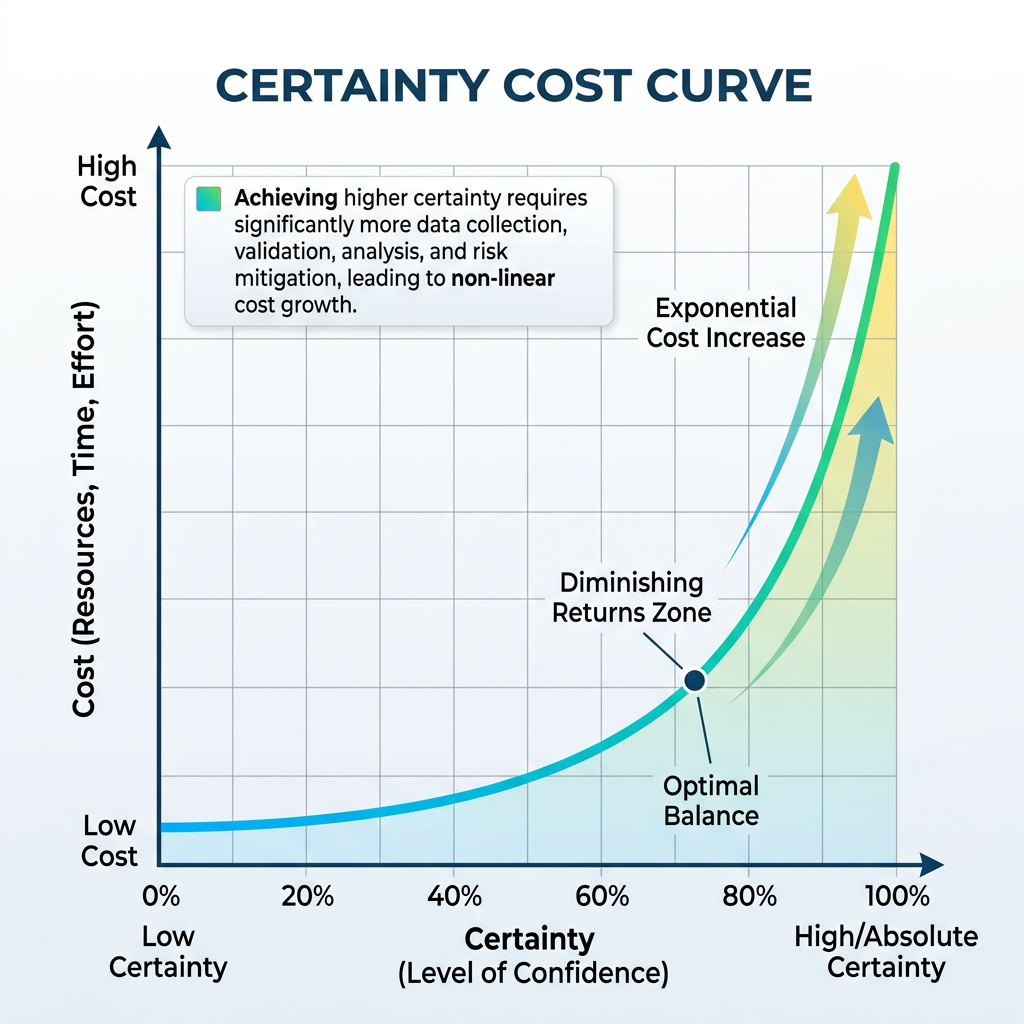
What nobody tells you is that information has a cost curve.
At low levels of certainty, additional information meaningfully reduces risk. After a threshold, the returns diminish sharply while the costs keep rising.
Most scaling founders crossed that threshold weeks ago, but they are still gathering, not because they need more information, but because certainty has become the condition attached to action – and that condition is quietly running up a bill.
THE ARCHITECTURE OF COURAGE
The Certainty Cost Curve
Certainty is not free. It has a carrying cost most founders never calculate. Here is how the curve works:
• Early information: meaningfully reduces risk, justifies the investment
• Mid-range information: reduces risk incrementally, cost begins to match return
• Late information: marginal risk reduction at increasing cost
• Excess information: no meaningful risk reduction – only compounding overhead
The threshold arrives earlier than the brain’s risk management system accepts. The system is designed
to keep gathering. Every new piece of information feels like progress. Every remaining uncertainty feels
like a gap that needs closing.
There is one behavior that signals the threshold has been crossed:
“You are refining a decision you have already effectively made.”
When the analysis is no longer surfacing new considerations – when you are circling the same variables with slightly different frameworks – you are past the threshold. You are not reducing risk. You are paying the certainty overhead.
Overhead 1 – Time Cost
Every week spent gathering certainty past the threshold, narrows the decision’s execution window. In markets that move, time spent on excess analysis is market position forfeited.
Overhead 2 – Cognitive Cost
Certainty-seeking past the threshold consumes cognitive bandwidth without producing useful output.
The founder is working hard and generating nothing actionable. This is the overhead that produces the feeling of being busy and stuck simultaneously.
Overhead 3 – Identity Cost
Each additional cycle of certainty-seeking sends one message to the internal architecture: this decision requires more preparation. The more cycles, the higher the implicit bar becomes – not based on what the decision requires, but on how much preparation the pattern has normalised.
COURAGE ECONOMICS
The Certainty Tax
Certainty beyond the threshold is a tax – paid in time, opportunity, and execution velocity. It compounds in three ways:
1. The Delay Multiplier
Every additional week of certainty-seeking multiplies the original decision’s cost. The hiring decision you delayed costs not just the week of delay – it costs every week of under-capacity the unfilled role created.
2. The Competitor Discount
While you are gathering, the market continues moving. Competitors operating at a lower certainty threshold are not being reckless. They are capturing the window premium you are paying to avoid. Your excess caution is their competitive advantage.
3. The Momentum Penalty
Execution following an extended certainty-gathering cycle carries a momentum deficit. The conviction available at the optimal decision point does not hold indefinitely. Late execution often underperforms not because the decision was wrong – but because the momentum required to execute it well has dissipated during the gathering period.
FOUNDER PSYCHOLOGY
Why High-Achievers Pay the Highest Certainty Tax
The certainty threshold problem is disproportionately a high-achiever problem.
High performers were rewarded throughout their careers for thoroughness. The person who asked the
right clarifying question before acting was the one who got promoted. “Let me think about this more carefully” built reputations in institutions.
That conditioning follows you in. And it becomes the most sophisticated-sounding justification for inaction available:
Not “I’m afraid to move.” But “I need more information.”
Not “I don’t want to commit.” But “I want to be sure.”
The two sentences are functionally identical. But the second passes the internal quality check that the first does not.
Recognising the difference is where the overhead stops accumulating.
WEEK 12 IMPLEMENTATION BLUEPRINT
The Certainty Audit
Step 1 – Name the decision.
Identify one significant decision you have been in the analysis phase on for longer than three weeks.
Step 2 – Run the threshold test.
Answer three questions:
• What information am I still gathering?
• What would that information change about the decision?
• If I received it today, would the decision be made – or would I identify the next gap?
If the answer to the third question is “I would identify the next gap”- you are past the threshold. You are manufacturing conditions for delay, not reducing risk.
Step 3 – Calculate the weekly overhead.
For every week past the threshold: what has the certainty-seeking cost in time, cognitive load, and execution momentum? Name a specific consequence. Make the tax visible.
Step 4 – Set the minimum viable certainty.
What is the least information you need to make this decision responsibly? That is your threshold.
Anything beyond it is overhead. Draw the line and act from there.
SIGNAL OF THE WEEK
Courage Signal: When a decision feels like it needs just one more piece of information – ask whether that information would change the decision or simply make it feel more comfortable. If the answer is the latter, you have already crossed the threshold. The remaining gathering is not due diligence. It is overhead.
THE ARCHITECT’S CLOSING NOTE
Certainty is not a virtue. Precision is.
The precise founder knows exactly how much certainty each decision requires – and stops there.
The certainty-seeking founder keeps gathering past the threshold, paying the overhead, and calling it diligence.
Every decision has a minimum viable certainty level. Below it, more information genuinely helps. Above it, more information is a cost centre dressed as a quality standard.
Find the threshold. Draw the line. That is where execution begins.
Warm courage,
Daniel Aideyan
The Courage Architect
Creator of The Courage Economy™
P.S. Which decision are you currently gathering certainty on past the threshold? Reply with the decision and the information you’re still waiting for. The pattern in this community’s answers consistently reveals where the highest collective overhead is sitting.
Leave a Reply