
There is a concept in accounting that every founder knows intellectually.
Sunk costs.
Money already spent. Unrecoverable. Irrelevant to every future decision.
The principle is simple: what something costs to build has no bearing on whether you should keep it.
Every founder understands this about money, but almost no founder applies it to identity.
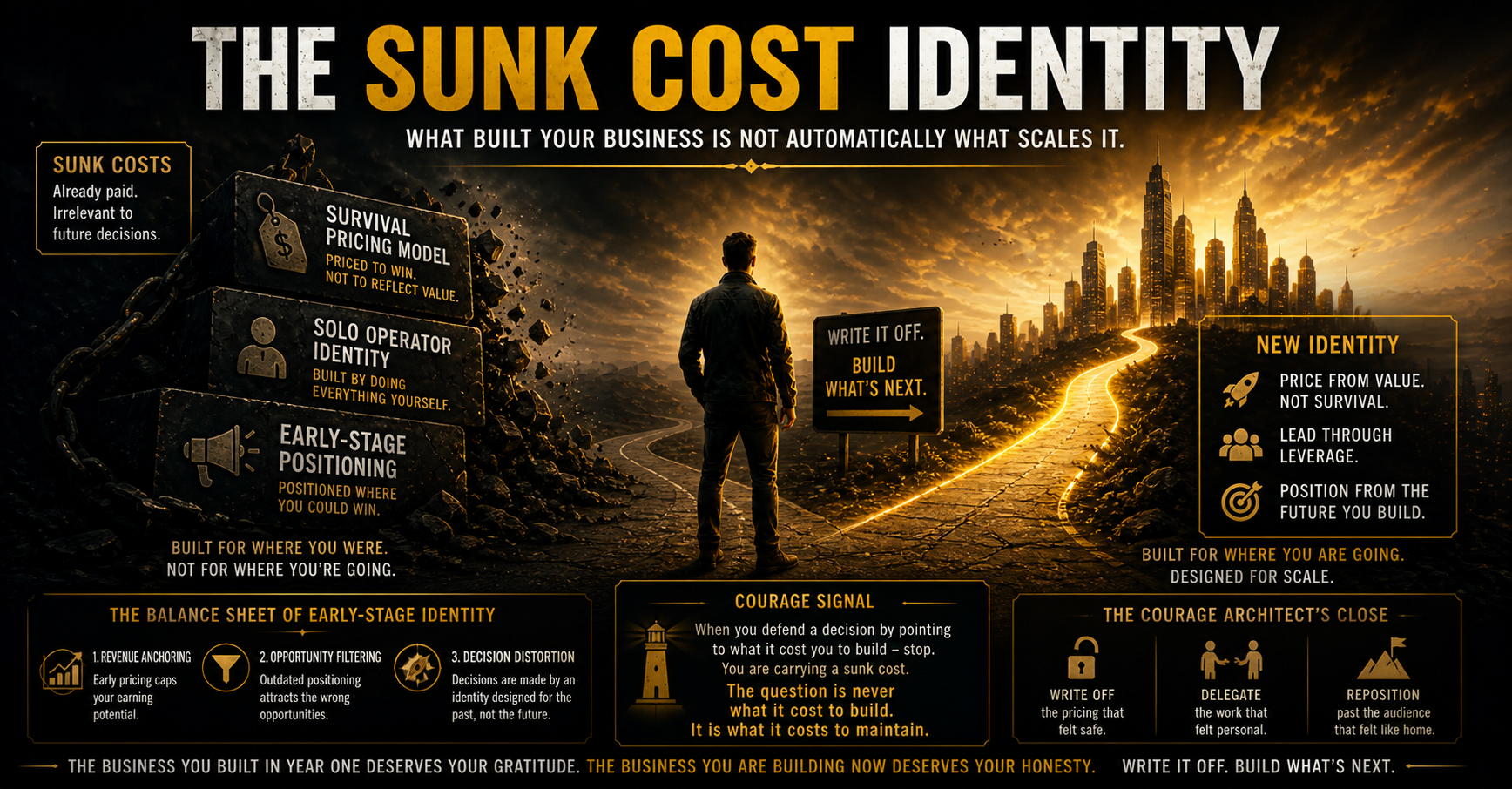
The pricing model that won your first clients is a sunk cost.
The solo operator identity that built your reputation is a sunk cost.
The positioning you built when you were finding your voice is a sunk cost.
All of it has already returned the value it was capable of returning, and all of it is still sitting on your balance sheet – distorting every decision you make about what comes next.
THE ARCHITECTURE OF COURAGE
How Early-Stage Identity Becomes a Scaling-Stage Ceiling
Every identity is built in response to specific conditions. The early-stage founder built an identity exactly right for the problem it solved:
• Prove the business is real
• Win the first clients without established credentials
• Operate lean enough to survive
• Build trust at close range
That identity worked. It was the right architecture for those conditions. However, the conditions have changed, the business has grown, the evidence has accumulated, but the identity has stayed exactly where it was.
Now it is not protecting you. It is containing you.
Sunk Cost 1 – The Survival Pricing Model
You priced to win – not to reflect value, but to reduce friction and get in the door. That pricing built the client base and created the proof the business needed to exist. It has fully served its purpose, but raising it significantly feels like a betrayal of the relationships built at that price. That is a sunk cost controlling a live decision – capping your revenue at the ceiling of your earliest clients’ willingness to pay.
Sunk Cost 2 – The Solo Operator Identity
You built the business by doing everything yourself. That identity became the brand. But it has a hard capacity ceiling. The business cannot scale past your hours. You know this, and you still have not delegated what needs to be delegated – because doing so means letting go of the identity that built the business.
Sunk Cost 3 – The Early-Stage Positioning
You positioned yourself where you could win. It generated traction and an audience that knows who you are, but the business has moved. You are now presenting a previous version of the business to a market that would respond to the current one.
COURAGE ECONOMICS
The Balance Sheet of Early-Stage Identity
In accounting, sunk costs are written off. Not because they lack value – but because their value has been fully realised. Carrying them forward distorts future decisions.
Three economic consequences:
1. Revenue Anchoring
When pricing is emotionally tied to early-stage identity, revenue growth requires fighting the business’s internal architecture rather than expanding into the market opportunity.
2. Opportunity Filtering
Early-stage positioning creates an invisible filter on incoming opportunities. The market responds to the signal you are sending. If the signal is outdated, the opportunities that arrive are too.
3. Decision Distortion
Every significant decision made while carrying sunk cost identity is made from a distorted position. The pricing decision is made by someone still seeking permission to charge more. The expansion decision is made by someone operating from survival-stage risk tolerance. The decisions are live. The identity making them is not.
FOUNDER PSYCHOLOGY
Why Writing Off Early Success Feels Like Betrayal
The sunk cost fallacy is easy to identify in other people. It is almost impossible to see in yourself when the sunk cost is something you built with your own hands.
The early pricing did not just generate revenue. It generated confidence – it proved the business was wanted. Changing it significantly feels like risking the proof.
The solo operator model did not just deliver the work. It built relationships. Delegating feels like risking what people came for.
The early positioning did not just attract an audience. It created belonging. Repositioning feels like abandoning the people who showed up first.
“The sunk cost identity is not held in place by logic. It is held in place by gratitude – by loyalty to the version of the business that proved it could exist.”
That loyalty is not wrong, but loyalty to a past identity is not the same as loyalty to the business. The business needs you to write it off so it can become what it is capable of being next.
WEEK 10 IMPLEMENTATION BLUEPRINT
The Sunk Cost Audit
Step 1 – List your early-stage identity assets.
Write down the structures and positions established in the first twelve months of the business:
• Your original pricing or rate structure
• Your delivery model – how directly involved you remain in the work
• Your public positioning and the audience it was built for
• The niche or category you started in
• How you present your authority and credentials publicly
Step 2 – Run the sunk cost test on each one.
Question A: Has this fully served the purpose it was built for?
Question B: Is this still the right architecture for where the business is now, or is it architecture designed for problems the business no longer has?
Step 3 – Identify the one with the highest carrying cost.
Which early-stage identity asset is creating the most friction between where the business is and where it is capable of going? That is the one to write off first. Not all of them – the one with the highest carrying cost.
Step 4 – Name the write-off decision.
“The early-stage identity I am writing off is ____________. The decision that reflects the write-off is
____________.”
That sentence is your implementation this week—not the full repositioning, the decision that authorises it.
SIGNAL OF THE WEEK
Courage Signal: When you find yourself defending a business decision by pointing to what it cost you to build – the time, the relationships, the early sacrifices – you are not making a strategic argument. You are carrying a sunk cost. The question is never what it costs to build. It is what it costs to maintain.
THE ARCHITECT’S CLOSING NOTE
The most courageous thing a founder can do is not always the boldest external move.
Sometimes it is the internal one.
Writing off the pricing that felt safe.
Delegating the work that felt personal.
Repositioning past the audience that felt like home.
None of these is a betrayal. They are the accounting decisions of a founder who understands that what built the business is not automatically what scales it.
The business you built in Year One deserves your gratitude.
The business you are building now deserves your honesty.
It doesn’t have to be a different type of business, but it certainly has to be a different type of identity.
Write it off. Build what’s next.
Warm courage,
Daniel Aideyan
The Courage Architect
Creator of The Courage Economy™
P.S. Which sunk cost is carrying the highest price in your business right now? Reply and name it. The answers from this community consistently reveal patterns worth building the next layer of architecture around.
Leave a Reply