
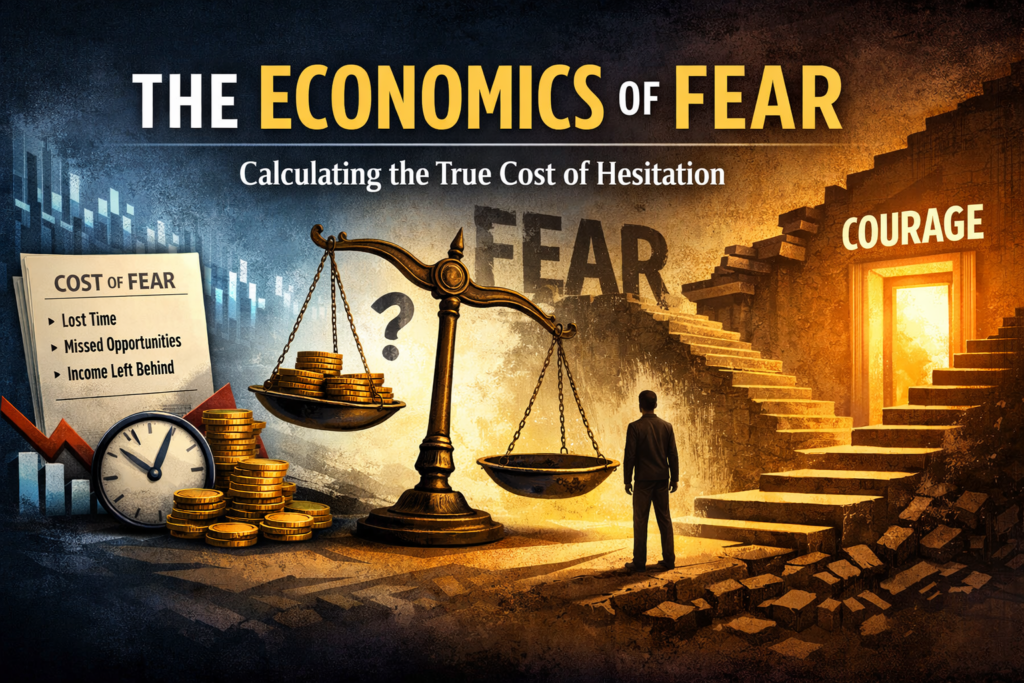
Every founder pays for fear.
Some pay with time, some with confidence, others with missed opportunities, and some with income left on the table.
One thing is certain: everyone pays.
Fear has an economic footprint – a measurable cost structure – and most founders never audit it.
Today’s briefing, which is the second episode in our “Transition Protocol” series, introduces the financial side of courage. I like to call it Courage Economics™ – it’s the study of how internal architecture shapes external earning power.
This is Blueprint #2: Quantifying the cost of fear so you can reclaim the execution capacity you didn’t know you were losing.
THE ARCHITECTURE OF COURAGE
Why Fear Is a Structural Problem, Not an Emotional One
Fear isn’t psychological weakness – it’s architectural misalignment.
Most founders think fear is:
- A mindset battle
- An emotional struggle
- A motivation issue
But fear is none of these. It is more.
Fear is the signal that your current identity architecture cannot support your next-level goals.
When identity lacks structural reinforcement, fear fills the gaps.
And when fear fills the gaps, execution slows.
This is why the most talented people often execute the slowest – their identity architecture was optimized for environments where courage wasn’t required.
The Three Structural Sources of Founder Fear
1. Identity Stretch
Fear increases whenever your next goal requires you to operate outside your conditioned identity.
If you were trained for stability, your nervous system resists volatility. If you were trained for approval, your system resists public iteration. If you were trained for perfection, your system resists speed.
Fear = friction between your current identity and your future identity.
2. Emotional Under-Capacity
Your architecture may not yet support:
- Public exposure
- Visible failure
- Rapid decisions
- Being wrong
- Imperfect execution
Fear grows not because the task is big, but because your emotional architecture hasn’t been upgraded yet.
3. Behavioral Rigidity
Fear becomes visible when your defaults conflict with entrepreneurship’s demands:
Old Default → “Wait until it’s perfect.” Founder Default → “Ship, then sharpen.”
Old Default → “Gather more information.” Founder Default → “Act on incomplete data.”
Old Default → “Protect reputation.” Founder Default → “Protect momentum.”
When defaults clash, fear becomes the system’s alarm.
Fear isn’t a warning to stop – it’s a signal to upgrade architecture.
COURAGE ECONOMICS™
The Financial Cost of Fear (And Why It’s Higher Than You Think)
Fear has a Balance Sheet.
You pay for fear in four measurable currencies:
1. The Cost of Delay (Time Currency)
Every delayed action compounds into:
- Lost momentum
- Lost opportunities
- Lost reputation cycles
A founder who delays for 3 days per decision loses over 120 days of execution per year.
Delay is the most expensive form of fear because it compounds silently.
2. The Cost of Incomplete Decisions (Cognitive Currency)
Fear hijacks cognitive bandwidth.
When fear loops activate, founders lose:
- Strategic clarity
- Idea quality
- Perceptual accuracy
- Decision sharpness
A mind running fear cycles operates at 40–60% capacity.
This means: You can be smart, skilled, and experienced – and still operate at half your potential because fear is taxing your internal CPU.
3. The Cost of Hidden Opportunities (Market Currency)
Fear reduces:
- Visibility
- Outward confidence
- Perceived value
- Market magnetism
- Partnership potential
Your fear becomes invisible but detectable.
People feel whether you are architected for courage or not.
Markets respond by opening or closing.
Courage is an economic signal. Fear is a velocity tax.
4. The Cost of Identity Inconsistency (Self-Trust Currency)
Every time you delay something you know you should do, you make a hidden withdrawal from your internal trust account.
Self-trust decreases.
Execution hesitation increases.
Identity confidence weakens.
Future decisions become harder.
Identity is compounding – upward or downward.
FOUNDER PSYCHOLOGY
The Fear-Cost Loop That Quietly Shrinks Your Vision
For high-achievers, the fear loop often looks like this:
Fear → Delay
Delay → Internal Negotiation
Internal Negotiation → Mental Exhaustion
Mental Exhaustion → Avoidance
Avoidance → Reinforced Fear
Reinforced Fear → Shrinking Vision
The more you avoid, the smaller your goals become. Not because you lack potential – but because you’ve trained your architecture to retreat from emotional exposure.
This is why so many brilliant founders build small businesses: Their identity cannot yet hold the emotional cost of building a big one – and this is not a dig on small businesses, it is to show that many founders are operating below their capacity because they have not built the architecture to match their ambitions.
The solution isn’t motivation.
The solution is a new architecture.
WEEK 2 IMPLEMENTATION BLUEPRINT
Your Fear Balance Sheet Audit (15 Minutes)
Last week’s implementation blueprint was the 3-minute Courage Assessment Test. The test will help you improve your decision quality and identify where your execution architecture is limiting velocity. It is a complete diagnostics of your identity architecture across seven structural layers. You can take the test here – danielaideyan.com/assessment.
This week, you’ll quantify the cost of fear in your own business.
Step 1 – Identify one delayed decision
Something you “meant to do” but haven’t.
Step 2 – Calculate the time cost
How many days/weeks have you lost from hesitation?
Step 3 – Calculate the opportunity cost
What potential revenue or momentum was slowed?
Step 4 – Calculate the identity cost
What did this delay teach your identity? (To execute? Or to hesitate?)
Step 5 – Take a micro-courage action today
One email, one post, one ask, one test.
Courage compounds fastest in motion.
SIGNAL OF THE WEEK
Courage Signal: Decisions create identity faster than affirmations do.
Every time you choose speed over fear, your identity upgrades.
Every time.
THE ARCHITECT’S CLOSING NOTE
Fear is not the enemy. Fear is the invoice.
Every time you delay, overthink, or shrink, the invoice increases.
Every time you act, decide, or initiate, the invoice decreases.
Your job as a founder is not to get rid of fear.
Your job is to reduce its cost by upgrading the architecture it’s attached to.
See you next Tuesday – where we build the next structural layer.
Warm courage,
Daniel Aideyan
The Courage Architect
Creator of The Courage Economy™
P.S. Reply and tell me what you discovered in your Fear Balance Sheet Audit. Your insight might become next week’s case study.
Leave a Reply