
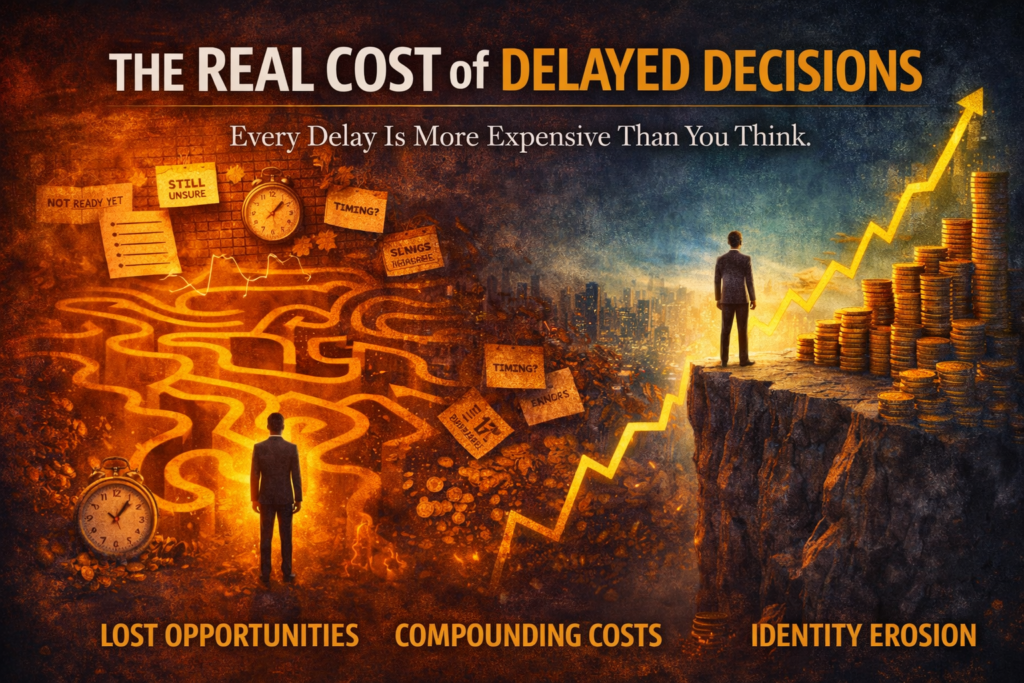
One of the most dangerous myths in entrepreneurship is this: “Staying where I am costs nothing.“
High-performing professionals entering entrepreneurship often delay bold moves because they believe:
- “I’m not ready yet.”
- “The timing isn’t right.”
- “I’ll revisit this after things settle at work.”
- “I need more clarity before I commit.”
But through the lens of courage architecture, here is the truth:
Every delay has a structure.
Every hesitation has an architecture.
Every stalled decision is powered by a design you never intentionally built.
Today’s briefing breaks down the identity mechanics and economic consequences of inaction – and gives you a framework to break the hesitation cycle permanently.
THE ARCHITECTURE OF COURAGE
The Invisible Architecture Behind Every Delayed Decision
Hesitation isn’t a behavior problem.
It’s an identity architecture problem.
Below are the three silent structural components that create the illusion of “not being ready.”
1. Identity Lag
Identity lag is the gap between:
- The identity you currently operate from
- The identity your goals require
People don’t procrastinate tasks, they procrastinate identity upgrades.
When your internal architecture isn’t built for entrepreneurship, delayed decisions become your default.
It feels rational – but it is identity-based.
2. Emotional Overload Disguised as Logic
Fear rarely announces itself as fear.
It often disguises itself as:
- “Let me gather more information…”
- “I’ll revisit this next quarter…”
- “I need more clarity…”
Behind the scenes: Your emotional architecture is overloaded.
Your body is signaling danger while your mind scripts elegant explanations.
Courage isn’t “feeling ready.”
Courage is the architecture that lets you act while feeling unready.
3. Cognitive Drift
When you delay a decision, your mind begins projecting alternate timelines:
- “What if I fail?”
- “What if the market shifts?”
- “What if I lose money?”
- “What if this doesn’t work?”
This drift is costly.
It burns cognitive bandwidth.
It weakens confidence.
It erodes entrepreneurial identity.
Courage replaces drift with design – decisions built on structure, not emotional turbulence.
COURAGE ECONOMICS
The Real Cost of Delayed Decisions
In the Courage Economy™, delay is never neutral.
Delay is expensive.
Here are the four economic losses created by inaction:
1. Compounding Opportunity Loss
Every courageous decision yields compounding returns:
- Skills you would’ve built
- Relationships you would’ve formed
- Opportunities you would’ve recognized
- Momentum you would’ve gained
- Identity upgrades you would’ve integrated
When you delay, you lose the exponential curve, not just the first step.
2. Market Loss
Markets reward:
- The one who launches
- The one who iterates
- The one who moves without waiting for validation
Delayed decisions lead to:
- Lost timing
- Lost visibility
- Lost learning cycles
- Lost momentum
In the Courage Economy™, speed is currency, and every delay costs you capital.
3. Psychological Inflation
The longer a decision is delayed, the heavier it becomes.
A 5-pound decision today becomes a 50-pound decision in 90 days.
Inflation in courage economics means:
- Fear grows
- Doubts multiply
- Risks feel larger
- Confidence shrinks
You pay more later for what you should have done now.
4. Identity Devaluation
Every moment you delay a meaningful decision, you send this message to yourself:
“I am not someone who moves.”
Your identity listens.
Identity determines income.
Identity determines execution.
Identity determines possibility.
Delayed decisions weaken identity – and weakened identity shrinks your future.
FOUNDER PSYCHOLOGY
Why High-Achievers Struggle Most With Inaction
High-performing professionals often have the hardest time with decisive action.
Why?
Because they’ve been rewarded for thoroughness, not speed.
They’ve been trained to:
- Analyze extensively
- Minimize risk
- Seek consensus
- Perfect before presenting
These habits served them well in corporate environments. These same habits paralyze them as entrepreneurs.
The irony: The more successful you were as an employee, the more dangerous inaction becomes as a founder.
Your corporate training can be your entrepreneurial handicap.
WEEK 5 IMPLEMENTATION BLUEPRINT
The 5-Minute Decision Reset
A courageous life is built through courageous decisions.
This week, ask yourself:
1. What decision have I delayed that I already know is right?
2. What identity shift is this decision asking of me?
3. What is the cost of delaying this another 30 days?
4. What micro-action can I take in the next 24 hours?
5. Who do I become when I act? Who do I become when I don’t?
Your decisions shape your architecture.
Your architecture shapes your execution.
Your execution shapes your outcomes.
It all begins with one courageous move this week.
SIGNAL OF THE WEEK
Courage Signal: The most expensive decisions aren’t the ones we make – they’re the ones we postpone.
THE ARCHITECT’S CLOSING NOTE
Every moment of inaction is a moment of decision.
You’re deciding that comfort is worth more than growth.
You’re deciding that safety is worth more than possibility.
You’re deciding that certainty is worth more than courage.
These are expensive decisions.
The cost shows up later – in regret, in missed opportunity, in identity you never built.
Make one courageous decision this week.
Not perfect. Just decisive.
Warm courage,
Daniel Aideyan
The Courage Architect
Creator of The Courage Economy™
P.S. The decision you’re delaying right now? That’s your biggest opportunity. Not because it’s easy – because it’s the exact shape of your next identity upgrade.
Leave a Reply