
Every founder begins with a burst of courage – the spark, the idea, the decision to begin.
However, what separates those who start from those who sustain is simple:
They build courage that lasts.
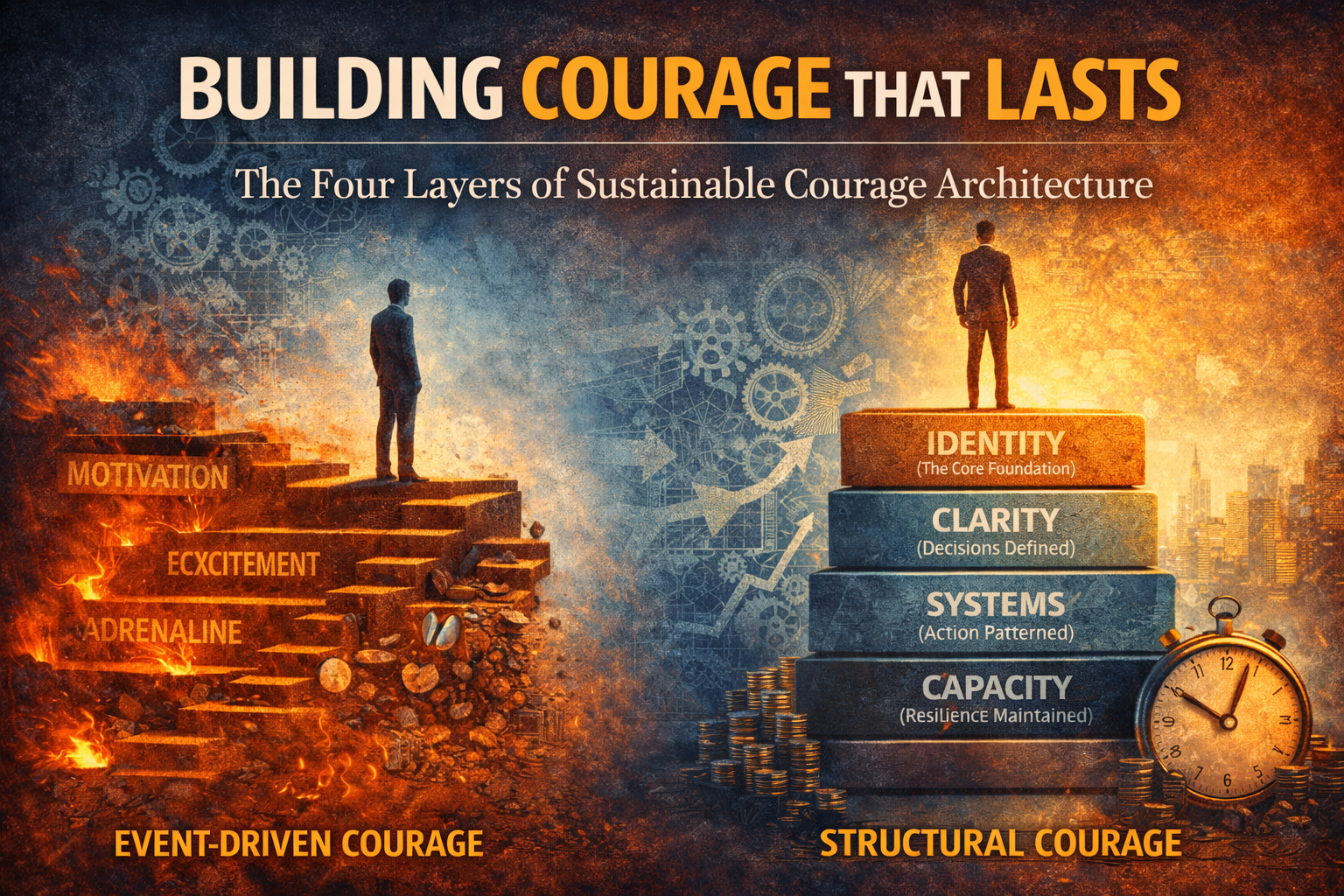
Most people build courage like motivation: temporary, emotional, and event-driven.
Real founders build courage like architecture: structural, repeatable, and independent of feelings.
In today’s briefing, we break down:
- Why short-term courage collapses under long-term pressure
- The four layers of sustainable courage architecture
- Why courage economics rewards duration, not intensity
- A practical system for courage that compounds over decades
This is one of the most important issues in the entire eight-part “Transition Protocol” series.
This shift takes you from a courageous moment to a courageous identity.
THE ARCHITECTURE OF COURAGE
Why Most Founders Burn Out: Event-Driven Courage vs. Structural Courage
Most founders don’t fail because they lack courage. They fail because they rely on event-based courage.
Event-based courage includes:
- The courage to launch
- The courage to quit
- The courage to send a pitch
- The courage to try something new
These moments matter – but they are unstable.
Event-driven courage depends on emotion. Emotion is volatile, and volatility cannot sustain entrepreneurship.
Founders need structural courage – courage that holds under pressure and renews itself.
Below are the four layers of long-term courage architecture.
Layer 1 – Identity Courage (The Core Foundation)
Your identity dictates how you interpret:
- Risk
- Failure
- Rejection
- Opportunity
If your identity is built around:
- Approval
- Perfection
- Safety
- Comfort
…you cannot sustain courage, no matter how much motivation you consume.
Identity courage is definitional, not emotional.
It sounds like: “Courage is who I am, not what I feel.”
This is the true foundation of long-term courage.
Layer 2 – Clarity Courage (The Structural Framework)
Unclear founders hesitate. Clear founders act.
Courage collapses when:
- The path is ambiguous.
- Decisions pile up
- You’re overwhelmed
- The next step is undefined.
Clarity removes uncertainty. Removing uncertainty removes fear.
The founder who knows what to do next will always outperform the founder who is guessing.
Layer 3 – System Courage (The Execution Blueprint)
Even the strongest identity and the clearest vision will collapse if execution depends on mood.
System courage means courage is built into:
- Processes
- Workflows
- Decision triggers
- Weekly routines
Examples:
- A weekly “courage decision window”
- A structured process for difficult conversations
- A courage scoring system for opportunities
- A reflection ritual for fear signals
Systems preserve courage when energy dips.
Systems ensure action continues even when you don’t feel bold.
Layer 4 – Capacity Courage (The Reinforcement Engine)
If your physical, mental, and emotional capacity erodes, courage collapses with it.
Most founders underestimate the impact of:
- Fatigue
- Bandwidth limitations
- Stress
- Sleep deprivation
- Being overwhelmed
- Lack of recovery
Courage is a high-energy identity. Exhaustion destroys courage faster than fear.
Capacity courage means you engineer your life to support sustainable courage.
When all four layers are built:
- Identity holds
- Clarity stabilizes
- Systems execute
- Capacity reinforces
This is the courage that lasts. This is architectural courage.
COURAGE ECONOMICS
The Compound Effect of Long-Term Courage
In courage economics, there are two types of founders:
1. Short-Term Courage Founders
They experience:
- Activity spikes
- Long hesitation plateaus
- Cycles of excitement and fear
- Inconsistent growth
- Fragile confidence
2. Long-Term Courage Architects
They experience:
- Consistency
- Compounding execution
- Predictable progress
- Rising opportunity flow
- Stable identity confidence
Why?
Courage economics rewards duration, not intensity.
The founder with small courage daily outperforms the founder with big courage monthly.
Courage behaves like capital:
- Sporadic deployment does not always multiply.
- Consistent deployment compounds
And here is the power law:
Founders who consistently take courage-based actions become founders who consistently receive courage-based opportunities.
People respond to:
- Your consistency
- Your stability
- Your identity alignment
- Your decisive execution
- Your courage under pressure
Opportunities chase courageous people.
This is why courage is both psychological and economic.
FOUNDER PSYCHOLOGY
When Emotional Courage Isn’t Enough
Early in my founder journey, I realised I was relying on emotional courage instead of architectural courage.
One moment made this clear:
I’d launched a new initiative with massive enthusiasm – fueled by adrenaline, vision, and the high of possibility.
Three weeks later, when the initial excitement faded and the grind set in, I found myself hesitating on the exact actions that would move the work forward.
My courage hadn’t failed. My architecture had.
I was depending on feelings to sustain what only structure could maintain.
When I rebuilt the four layers, everything shifted:
- Identity courage made bold action my default.
- Clarity courage eliminated decision paralysis
- System courage automated execution when motivation dipped
- Capacity courage kept me operating at peak performance
This experience became the blueprint for today’s briefing.
Sustainable courage isn’t found in moments. It’s built in systems.
WEEK 7 IMPLEMENTATION BLUEPRINT
The Courage Action for the Week
Choose one layer and strengthen it today.
Identity
Rewrite one fear-based identity belief.
Clarity
Define your next 7-day execution strategy.
Systems
Install one courage trigger (e.g., a weekly risk window).
Capacity
Remove one energy-draining pattern.
Small architectural shifts create massive economic outcomes.
SIGNAL OF THE WEEK
Courage Signal: Courage is not a personality trait you’re born with. It’s an architecture you build deliberately.
THE ARCHITECT’S CLOSING NOTE
If today’s briefing gave you clarity or courage, forward it to a founder who needs it.
The Courage Economy grows every time courage is chosen over comfort.
Warm courage,
Daniel Aideyan
The Courage Architect
Creator of The Courage Economy™
P.S. Most founders fail not from lack of courage, but from lack of courage architecture. Build the systems that make courage sustainable.
Leave a Reply