
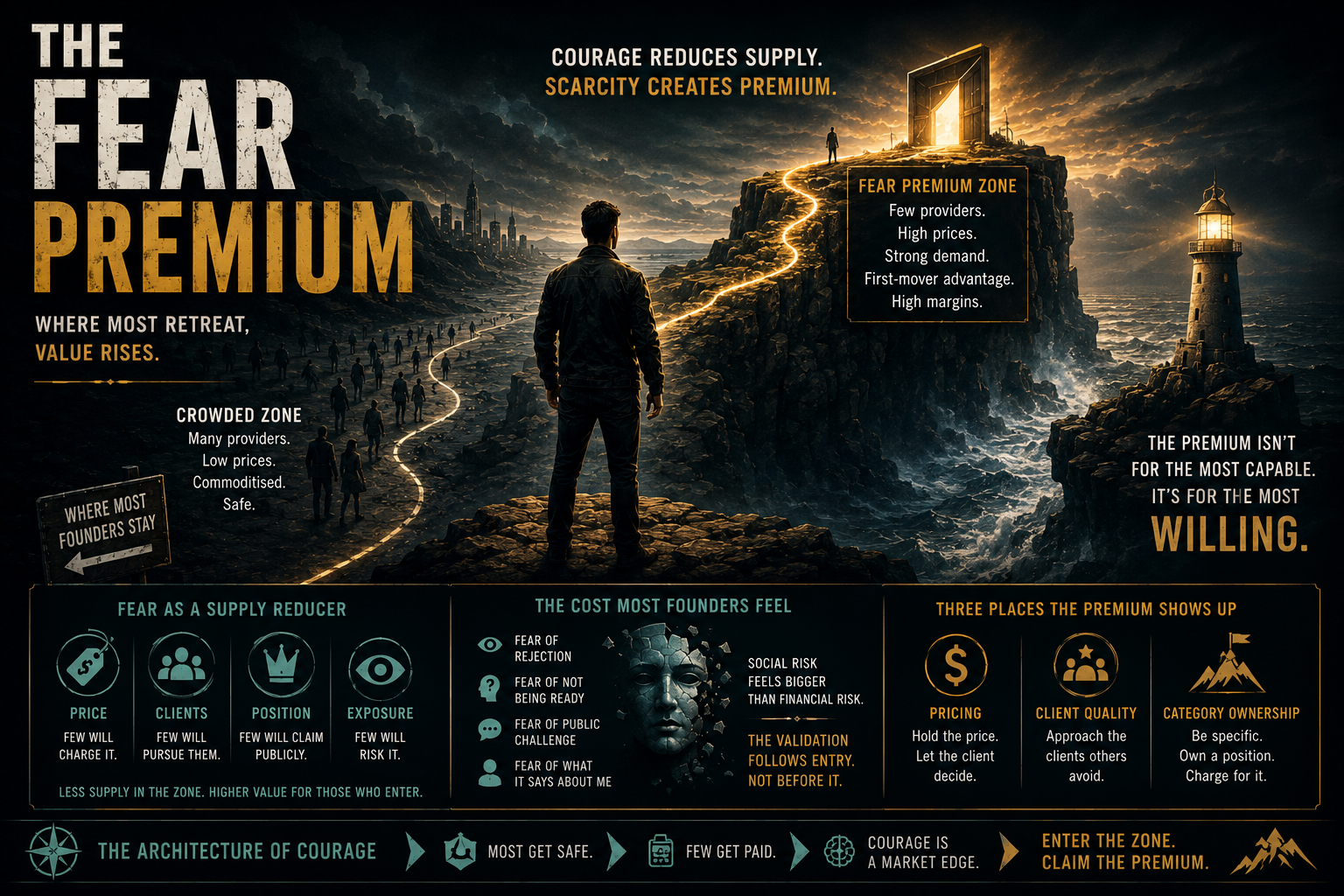
There is a reason most founders price based on what the market will accept, even though the highest-margin founders’ price is based on where they are willing to go and not fear.
These are not the same calculation.
There is a zone in every market where margins are structurally higher, not because the work is more complex, but because the founder is more credentialed, and most capable people will not go there.
Fear acts as a supply reducer. When capable founders route around a zone of genuine demand, supply in that zone contracts, and when supply contracts where demand is strong, price rises.
That elevated price has a name.
“The fear premium is the structural price advantage available to founders willing to operate where their competitors will not go.”
This is not a motivational concept. It is a market structure observation, and understanding it changes the entire frame around what courage is for.
THE ARCHITECTURE OF COURAGE
Fear as a Supply Reducer
Every market has zones. Some zones are crowded – many capable providers, compressed margins, commoditised positioning. Other zones are sparse -few providers, elevated margins, significant first-mover advantage.
The standard explanation for sparse zones is capability: not enough people have the skills to operate there. This is sometimes true. But in most knowledge-work, service, and expertise markets, the actual explanation is different. The sparse zones require courage, and not just capability.
They require:
• Charging a price that forces the client to make a real decision
• Claiming a position of authority before full external validation exists
• Approaching clients whose scale feels ahead of your current identity
• Holding a specific, exposed market position that can be publicly challenged
• Delivering work whose outcomes are visible and attributed to you
The founders who could operate in these zones often don’t. Not because they lack capability, but because the courage cost of entry feels higher than the financial reward. That calculation is usually wrong, and it is the source of the fear premium for those willing to enter.
COURAGE ECONOMICS
Three Places the Fear Premium Is Visible in Your Market
Premium Zone 1 – Pricing Itself
The founder who holds a price significantly above market rate is not always more capable than the one at market rate. They are more willing to sit in the discomfort of a price that requires the client to decide.
Most founders lower their prices to ease that discomfort. The premium accrues to those who don’t.
Premium Zone 2 – Client Quality
The clients who pay the highest rates and create the greatest leverage are underserved in most markets – not because no one can help them, but because most founders route around the discomfort of approaching them.
The conversation feels too big. The contract feels ahead of where they are. The fear of rejection at that level feels more costly than the revenue foregone.
It is not.
Premium Zone 3 – Category Ownership
The founder who holds a clear, specific, named position in their market commands a premium that generalists never access.
Category ownership requires the courage of specificity: being publicly wrong about what you stand for. Being challenged on a position you have claimed.
Most founders choose vagueness because it cannot be wrong. Vagueness also cannot be premium.
FOUNDER PSYCHOLOGY
The Social Risk Is Higher Than the Financial Risk
Most founders avoid the fear premium zone not because of financial exposure. The financial risk of charging more, pursuing larger clients, or claiming a specific position is often lower than the risk of staying where they are.
They avoid it because of social risk – the perceived cost of being seen as overreaching. Of holding a price before feeling fully credentialed for it. Of claiming territory in a zone not yet publicly validated.
The internal calculation runs like this:
“What if I charge this and they say no – what does that mean about me?“
“What if I approach that client and they don’t take me seriously?“
“What if I claim this position and someone challenges it publicly?“
These are identity questions dressed as risk assessments. The fear premium zone requires you to operate from your current evidence – not from the external validation you are still waiting to receive. The validation follows entry. It does not precede it.
WEEK 13 IMPLEMENTATION BLUEPRINT
Locating Your Fear Premium Zone
Step 1 – Map the discomfort gradient in your market.
Where does the work in your market require the most courage to claim or deliver?
Not the most skill – the most courage. Mark that zone specifically.
Step 2 – Identify the supply constraint.
How many of your direct competitors consistently operate in that zone?
The fewer the providers, the higher the premium available. If the answer is almost none, you have located significant pricing power that is currently unclaimed.
Step 3 – Name the specific fear blocking entry.
What specifically makes that zone feel inaccessible right now?
A price that feels ahead of your current self-concept? A client profile that feels too large? A public position that feels exposed to challenge?
Name it precisely. Vague fear cannot be acted on. Named fear can.
Step 4 – Identify the smallest entry move.
What is the single smallest action that places you inside the fear premium zone this week?
Not the full repositioning. The first move requires you to absorb the social risk you have been avoiding.
SIGNAL OF THE WEEK
Courage Signal: The zone in your market that makes you most uncomfortable to claim publicly is almost certainly the zone where your margins would be highest. Discomfort is not a warning to stay out. In a market context, it is a supply signal pointing toward a premium.
THE ARCHITECT’S CLOSING NOTE
The Courage Economy is built on one foundational market insight:
Courage is a competitive advantage because most people avoid it.
That is not a motivational statement. It is a supply and demand observation. Where most founders retreat, supply contracts. Where supply contracts in a zone of genuine demand, price rises, and the founder is willing to stay commands it.
The fear premium is not waiting for you to become more capable; it is waiting for you to become more willing.
Those are not the same thing, and only one of them is already inside you.
Enter the zone. Claim the premium.
Warm courage,
Daniel Aideyan
The Courage Architect
Creator of The Courage Economy™
P.S. Name the zone in your market you have been routing around, and reply with what specifically makes it feel inaccessible. The named fear is always smaller than the unnamed one.
Leave a Reply