
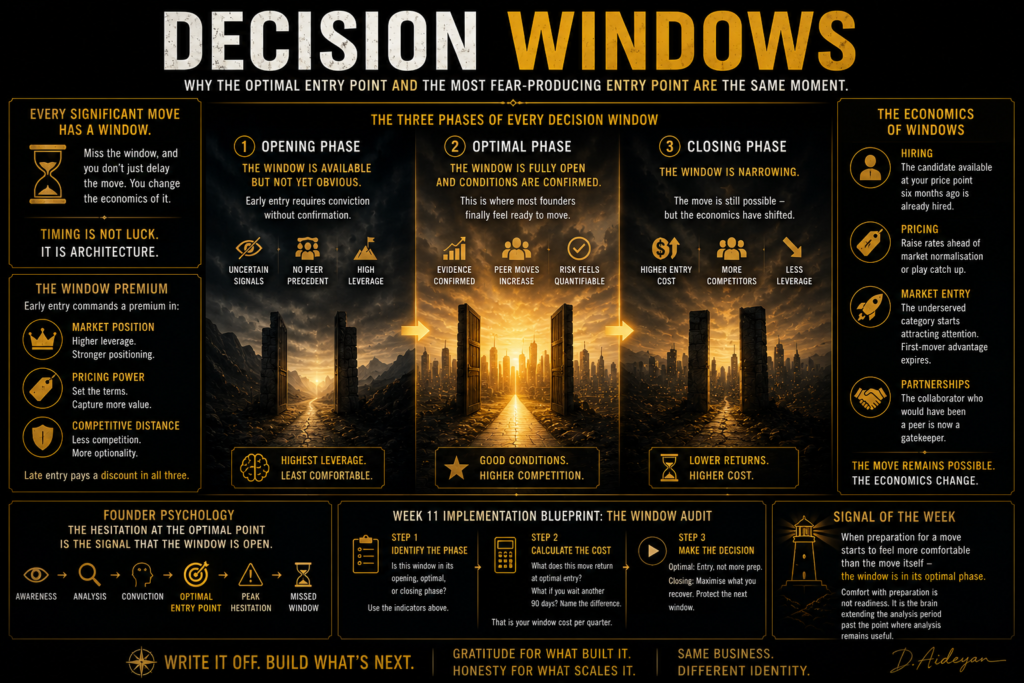
Every significant move has a window.
Not a deadline. A window, a period during which the cost of entry is lower, the market is more receptive, and the conditions support the move in a way that they will not six months from now.
Miss the window, and you do not just delay the move. You change the economics of it.
The same decision, made after the window closes, costs more, converts less, and competes harder.
Timing is not luck. It is architecture.
THE ARCHITECTURE OF COURAGE
The Three Phases of Every Decision Window
The Opening Phase
The window is available but not yet obvious. Early entry requires conviction without confirmation – which is exactly why most founders do not enter here. The market has not yet validated the move. The peer group has not yet normalized it. The evidence base exists but has not compounded into certainty.
This is the highest-leverage entry point, and the least comfortable one.
The Optimal Phase
The window is fully open and conditions are confirmed. This is where most founders first feel ready to move – because market signals are now legible, risk feels quantifiable, and peer precedent exists.
The cost: entry at this phase is more competitive. The advantage has been partially priced in. You are no longer early. You are on time – which is a different position entirely.
The Closing Phase
The window is narrowing. The move is still possible – but the economics have shifted. Higher entry cost.
Lower first-mover leverage. More competitors already positioned.
Most founders enter here. Not because they were unaware of the window – but because the optimal entry point and the most fear-producing entry point are the same moment.
The window does not wait for readiness. It operates on its own schedule.
COURAGE ECONOMICS
The Window Premium
Every decision window carries a pricing structure. Early entry commands a premium – in market position, pricing power, and competitive distance. Late entry pays a discount in all three.
For the scaling founder this plays out in measurable ways:
• Hiring: The candidate available at your price point six months ago has been recruited. The market has moved.
• Pricing repositioning: The window to raise rates ahead of market normalisation closes as competitors catch up.
• Market entry: The category you identified as underserved begins attracting attention. First-mover advantage expires.
• Partnership: The collaborator who would have been a peer is now a gatekeeper.
In each case, the move remained possible. The economics of the move changed.
The window premium appears on your balance sheet as the difference between what the move returns at optimal entry and what it returns now.
FOUNDER PSYCHOLOGY
Why the Optimal Entry Point Feels Like the Wrong Moment
Loss aversion does not respond to opportunity size. It responds to commitment weight.
The moment a window enters its optimal phase is the moment commitment becomes real – which is exactly the moment the brain escalates its resistance.
The scaling founder who has been watching a market develop, building conviction, gathering data – reaches the optimal entry point and experiences peak hesitation. Not because the analysis is wrong but because the analysis is complete, and completion removes the last legitimate reason not to move.
This is the psychological structure of missed windows:
Awareness → Analysis
Analysis → Conviction
Conviction → Optimal entry point
Optimal entry point → Peak hesitation
Peak hesitation → Post-window entry
Post-window entry → Diminished returns
The hesitation at the optimal entry point is not a signal to wait. It is a signal that the window is open.
WEEK 11 IMPLEMENTATION BLUEPRINT
The Window Audit
Identify one opportunity you have been tracking or considering for longer than 90 days.
Step 1 – Identify the phase.
Is this window in its opening, optimal, or closing phase?
Indicators of optimal phase: the move feels urgent but uncomfortable. Evidence is sufficient to proceed. Peer founders are beginning to make similar moves. The cost of waiting has become visible.
Step 2 – Calculate the window cost.
What does this move return at optimal entry?
What does it return if you wait another 90 days?
Name the difference. That is your current window cost per quarter.
Step 3 – Make the phase decision.
If optimal: The analysis is complete. The next action is entry, not more preparation.
If closing: The question is no longer whether to enter. It is what you recover from late entry and what you protect in the next window.
SIGNAL OF THE WEEK
Courage Signal: When preparation for a move starts to feel more comfortable than the move itself – the window is in its optimal phase. Comfort with preparation is not readiness. It is the brain extending the analysis period past the point where analysis remains useful.
THE ARCHITECT’S CLOSING NOTE
Most founders do not miss windows because they were unaware. They miss them because awareness and action are not the same thing.
You can track a window, analyse a window, discuss a window – and still watch it close from the preparation side of the threshold.
The founders who consistently enter at the optimal phase have built an architecture that treats the discomfort of optimal entry as the signal to move – not the signal to wait.
That architecture is buildable. That is the work.
Warm courage,
Daniel Aideyan
The Courage Architect
Creator of The Courage Economy™
P.S. Name the window you have been watching longest and reply with the phase it is currently in. The answers from this community consistently reveal where the highest collective window cost is sitting.
Take the Courage Assessment here – danielaideyan.com/assessment
Leave a Reply